FDA Requirements for Cosmetics: Your Complete Guide to FDA Approval
What are the FDA requirements for cosmetics and why should Indian brands care?
If you plan to sell skincare, haircare, makeup, or personal care products in the U.S., you must follow specific rules set by the Food and Drug Administration (FDA). These rules are called the fda requirements for cosmetics. They focus on product safety, correct labeling, and good manufacturing practices, even though the FDA does not “approve” most cosmetics before they reach the market.
For Indian cosmetic investors and brand owners, understanding these rules is a smart way to protect your business and unlock premium markets. Compliance reduces the risk of product recalls, customs delays, and legal trouble. It also makes global buyers and retailers more confident about stocking your brand.
By treating compliance as a growth strategy, not just a legal task, you can position your products as high-quality, safe, and globally ready.
Why FDA compliance matters for Indian cosmetic investors
When your products meet FDA requirements for cosmetics, you gain several long-term advantages. First, you show that your brand respects global safety standards. This builds trust with U.S. customers who are increasingly careful about what they put on their skin.
Second, many large retailers and online marketplaces prefer or require proof of regulatory compliance. This means following FDA rules can open doors to bigger orders and better margins. For Indian investors, this can turn a local cosmetic brand into a truly international opportunity.
Third, strong compliance reduces business risk. A well-documented safety and quality system makes it easier to answer any questions from partners, inspectors, or distributors.
Key documents you need before entering the U.S. market
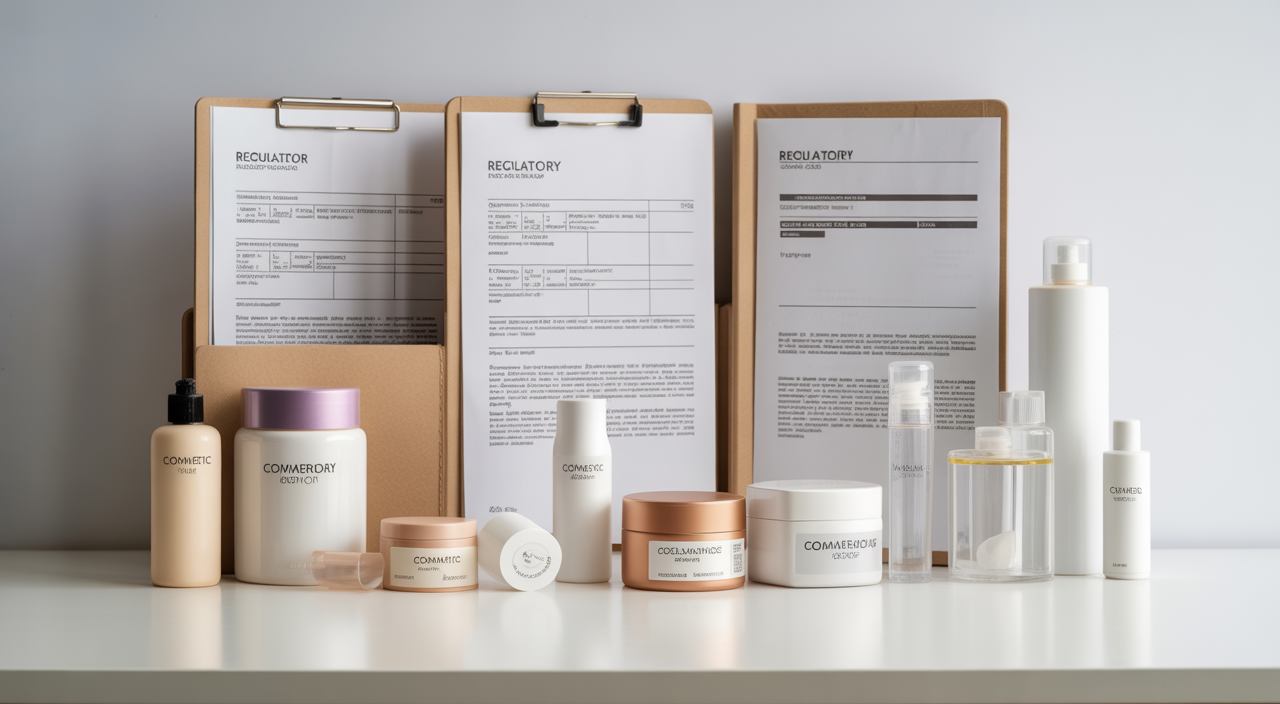
Before you ship even a single batch to the U.S., collect and organize these core documents. Think of them as your regulatory “file” for each product.
Mandatory documents include:
- Ingredient statement: A full list of ingredients using INCI names. INCI (International Nomenclature of Cosmetic Ingredients) is a standard way of naming cosmetic ingredients worldwide.
- Safety assessment report: A qualified toxicologist reviews each ingredient and the full formula to confirm it is safe for the intended use.
- Product label mock-up: A draft of your final label, showing the ingredient list, net quantity, product identity, and any warnings.
- Good Manufacturing Practice (GMP) records: Documents that show you follow clean, controlled, and consistent manufacturing processes.
- Manufacturing batch records: Details for each batch, such as lot number, production date, and key test results.
Optional but powerful documents:
- Stability test reports: Data showing the product stays stable, safe, and effective during its shelf life under different conditions.
- Microbial challenge test results: Tests that show the product resists harmful bacteria and fungi.
- Claims substantiation: Studies or data to support claims like “brightening,” “anti-aging,” or “reduces dark spots.”
- Certificates of Analysis (CoA): Quality reports from your raw material suppliers.
How long are these documents valid?
For investors, it is helpful to know how often these efforts must be repeated. A safety assessment report usually stays valid until you make a big change to the formula, such as adding a new active ingredient or changing preservatives.
Label records can stay valid for years if your claims, ingredients, and warnings stay the same. However, you should update them whenever regulations change or you modify the product. GMP and manufacturing documentation must be updated regularly and kept ready for inspection at all times.
Step-by-step path to meet FDA requirements for cosmetics
You can treat compliance like a clear, practical process. Here is a simple roadmap that works well for Indian brands aiming for the U.S. market.
- Formulation review: List every ingredient and check whether it is allowed in the U.S., and at what levels. Avoid restricted substances and banned colors or preservatives.
- Safety assessment: Hire a qualified toxicologist who understands U.S. cosmetic rules. They evaluate each ingredient, the total exposure, and any possible interactions.
- Label development: Design the label according to the FDA Cosmetic Labeling Guide. Include the product identity (what it is), net content, ingredient list in INCI order, and clear manufacturer or importer details.
- Manufacture under GMP: Implement written SOPs for hygiene, equipment cleaning, batch control, and staff training. Keep everything documented.
- Testing and documentation: Conduct stability and microbial tests, especially for products stored in hot or humid climates like India before export. File all results and CoAs.
- Record keeping: Maintain ingredient statements, safety reports, batch records, complaint logs, and distribution data in one organized system.
- Voluntary registration: Consider joining the FDA’s Voluntary Cosmetic Registration Program. It is not mandatory but signals transparency and professionalism.
- Launch and monitoring: After launch, track any customer complaints or adverse events and update documents or labels if needed.
Common mistakes Indian brands should actively avoid
Many problems arise from a few simple errors. Avoid these from the beginning:
- Skipping expert safety assessment to “save cost.” This can be far more expensive later.
- Using non-INCI ingredient names on labels, which confuses both regulators and consumers.
- Ignoring concentration limits for certain ingredients such as preservatives or colorants.
- Failing to document GMP. Good practice is not just what you do, but what you can prove you did.
- Making bold claims without scientific proof, like “removes all wrinkles” or “clinically proven” without data.
What can go wrong if you ignore FDA rules?
Even though this guide focuses on positive growth, it is useful to know the risks of non-compliance. The FDA can stop your products at the border, issue warning letters, or ask for recalls if they believe a product is unsafe or misbranded.
Beyond that, distributors may stop working with you if they see regulatory gaps. It can also be costly to re-label or reformulate after launch. Starting correctly protects both your reputation and your investment.
Approximate costs to plan for
Costs vary depending on your product type, number of SKUs, and how much you outsource. As a rough guide:
- Safety assessment report: around a few thousand dollars per formula, depending on complexity.
- Label review by a regulatory expert: several hundred to a little over a thousand dollars per label.
- Stability and microbial testing: typically under a few thousand dollars per formulation.
- GMP implementation and audit: a few thousand dollars, but this supports your entire product line.
For Indian investors used to planning capital expenditure, these are modest costs compared to the potential of the U.S. market.
How professional support can accelerate your U.S. entry
Working with a specialist regulatory partner is often the fastest way to reach compliance. A good partner can coordinate safety assessments, testing, labeling, and GMP in a structured way, saving you both time and rework.
If you are exploring global opportunities across sectors, you may also find it helpful to read about business consulting services that support growth planning and structured expansion. This kind of guidance, combined with strong cosmetic regulatory support, can help you scale your brand steadily.
For skincare-focused investors, learning how others position premium products, such as those highlighted in this overview of a rejuvenation face cream, can inspire you to shape claims and branding that remain compliant yet attractive.
Final thoughts for Indian cosmetic investors
Meeting FDA requirements for cosmetics is not just a legal checkbox. It is a powerful tool to build a strong, trusted, and scalable brand in one of the world’s most competitive beauty markets.
Start with clean documentation, solid safety assessments, and clear labels. Combine this with disciplined GMP and ongoing record keeping. With the right planning and expert support, your Indian cosmetic brand can confidently enter the U.S. market and grow with stability and trust.
FAQs on FDA requirements for cosmetics
Q1: Do all cosmetics need FDA approval before sale?
A1: The FDA does not usually approve cosmetics before they go to market. However, every cosmetic sold in the U.S. must be safe, properly labeled, and manufactured under good practices as per FDA rules.
Q2: What is an INCI name and why is it important?
A2: INCI stands for International Nomenclature of Cosmetic Ingredients. It provides a standard, globally recognized name for each ingredient. Using INCI names on labels makes your product clear and compliant for regulators and consumers.
Q3: Is GMP mandatory for cosmetic manufacturers targeting the U.S.?
A3: While specific cosmetic GMP rules are more flexible than for medicines, the FDA expects you to follow good manufacturing practices. Strong GMP helps prove your products are consistently safe and of good quality.
Q4: Can a small Indian brand afford U.S. cosmetic compliance?
A4: Yes. The costs are manageable if planned early and spread across batches and product lines. Treat compliance as a one-time foundation investment that supports future growth and investor confidence.

James Scott was born in Missouri and studied at the University of Central Missouri. Currently working as Manager at ActoutLoud, James Scott helps readers learn the fields of Law, Marketing, Construction, Education, Health, etc hone their skills, and find their unique voice so they can stand out from the crowd.
How to Cite This Article
James Scott. "FDA Requirements for Cosmetics: Your Complete Guide to FDA Approval." Act Out Loud, February 26, 2026. https://actoutloud.org/fda-requirements-for-cosmetics-your-complete-guide-to-fda-approval/