The Difference Between Decoupled and Headless Web Development
Introduction
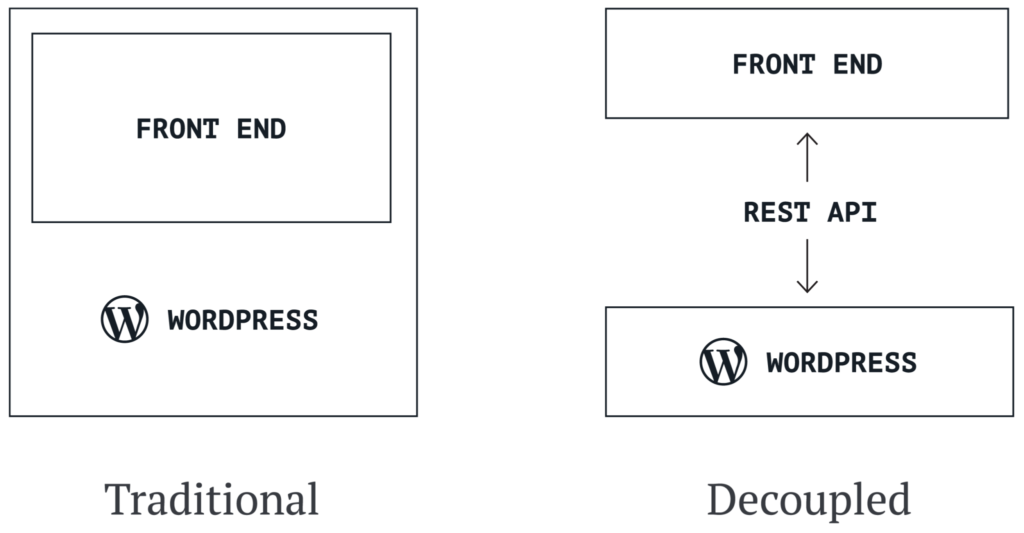
Decoupled architecture and headless CMS are two different approaches to web development. Decoupled architecture is a content management system based on an API that links the front-end website with the back end database. A headless CMS, on the other hand, is a content-only data which can be chosen and then injected into another platform. But how do these two work with each other? Discover in this article!
What are the Differences between Headless and Decoupled Web Development?
When it comes to web development, there are two main approaches that you can take: headless CMS and decoupled CMS. Both of these approaches have their own benefits and drawbacks, so it’s important to understand the difference between them before choosing which one is right for your project.
Headless WordPress web development is where you build the front-end of your website using a JavaScript framework such as React or Angular, and then the back-end is provided by a headless CMS such as WordPress or Drupal. The main benefit of this approach is that it allows for a separation of concerns between the front-end and back-end, which can make development faster and more efficient. However, one downside is that it can be more difficult to manage dependencies between the two parts of the system.
Decoupled web development is where you build both the front-end and back-end of your website as separate applications. The front-end application talks to the back-end application via an API, which means that they can be developed independently of each other. The main benefit of this approach is that it makes it easy to scale different parts of the system separately. However, one downside is that it can be more difficult to develop because you

Why is Headless CMS Better than Decoupled Architecture?
There are a few key reasons why a headless WordPress CMS is often seen as a better option than decoupled architecture:
- Greater flexibility and freedom – With a headless WordPress CMS, you can build your front-end using any technology or framework you want without being tied down to a specific platform. This gives you much greater freedom in terms of both development and design.
- Easier to scale – A headless WordPress CMS is much easier to scale than a decoupled one. This is because there is no need to duplicated content or functionality on multiple front-end applications.
- More cost-effective – headless WordPress CMSs are often more cost-effective than decoupled ones, as they require less development work overall. In addition, they can be hosted on cheaper infrastructure as there is no need for expensive servers and software licenses.
- Faster development – A headless WordPress CMS can be faster to develop than a decoupled one, as there is no need to develop multiple front-end applications. In addition, it can be easier to make changes and iterate quickly with a headless WordPress CMS as there is only one codebase to maintain.
- Greater control
What Are the Benefits of a Headless WordPress CMS?
A headless WordPress CMS provides a number of benefits over a traditional, coupled CMS. First, since the backend and frontend are decoupled, you can use any programming language or framework to develop the frontend. This gives you much more flexibility in terms of the technology you can use.
Second, a headless WordPress CMS is easier to scale than a traditional CMS. Since the frontend and backend are separate, you can scale them independently. This means that you can add more servers to the backend without affecting the frontend, and vice versa.
Third, a headless WordPress CMS is generally more secure than a traditional CMS. Since the frontend and backend are separate, an attacker would need to compromise both systems in order to take control of the website. This is much more difficult than compromising a single system.
Fourth, a headless WordPress CMS is often faster than a traditional CMS. Since the frontend and backend are separate, the backend can be optimized for speed without affecting the frontend.
Overall, a headless WordPress CMS provides many benefits over a traditional CMS. If you are looking for more flexibility, scalability, security, and speed, then a headless WordPress CMS is the right choice
How Does It Work?
Both headless CMS and decoupled CMS web development architectures involve separating the back-end server from the front-end client. In a decoupled architecture, the two are separate but still communicate with each other. In a headless architecture, the back-end server provides an API that the front-end client can access, but there is no direct communication between the two.
The main difference between these two approaches is that decoupled architectures tend to be more complex, as they require two separate systems to work together. headless WordPress architectures are simpler, as they only require a single system (the back-end API) to be operational.
Which approach is best for your project will depend on your specific needs and requirements. If you need a more complex system that can handle a lot of data and traffic, a decoupled architecture may be a better choice. If you need a simpler system that is easier to set up and maintain, a headless WordPress architecture may be the better option.
What Are the Drawbacks of a Headless WordPress CMS?
If you’re not familiar with the term headless WordPress CMS, it simply refers to a backend content management system that doesn’t have a front-end presentation layer. In other words, it’s a CMS that delivers content through an API instead of rendering HTML pages.
While a headless WordPress CMS has many advantages, there are also some potential drawbacks to consider. Here are a few things to keep in mind if you’re thinking about using a headless WordPress CMS for your next project:
- You’ll need to build your own front-end.
If you’re used to working with a traditional CMS that comes with a built-in front-end, then you’ll need to build your own when using a headless WordPress CMS. This can be time-consuming and may require additional skills or resources.
- It can be more difficult to manage content.
Since there’s no visual interface for managing content, it can be more difficult to keep track of everything without the help of a third-party tool or plugin. This can make it challenging for non–technical users to update content on their own.
- There’s no preview function.
Another downside of having no visual interface is that
Conclusion
Headless CMS and decoupled CMS web development are two approaches to building web applications. Both have their own benefits and drawbacks, so it’s important to understand the difference between them before deciding which one is right for your project.
In general, headless WordPress web development is better suited for projects that require a high degree of flexibility and customization. Decoupled web development, on the other hand, is more suited for projects that need to be built quickly and don’t require as much customization.
If you’re not sure which approach is right for your project, it’s always a good idea to consult with a web development expert. They can help you weigh the pros and cons of each approach and make the best decision for your specific needs.

James Scott was born in Missouri and studied at the University of Central Missouri. Currently working as Manager at ActoutLoud, James Scott helps readers learn the fields of Law, Marketing, Construction, Education, Health, etc hone their skills, and find their unique voice so they can stand out from the crowd.
How to Cite This Article
James Scott. "The Difference Between Decoupled and Headless Web Development." Act Out Loud, April 14, 2022. https://actoutloud.org/headless-wordpress-vs-decoupled-cms/