Automated Financial Reporting Melbourne: Streamline Your Business Reporting
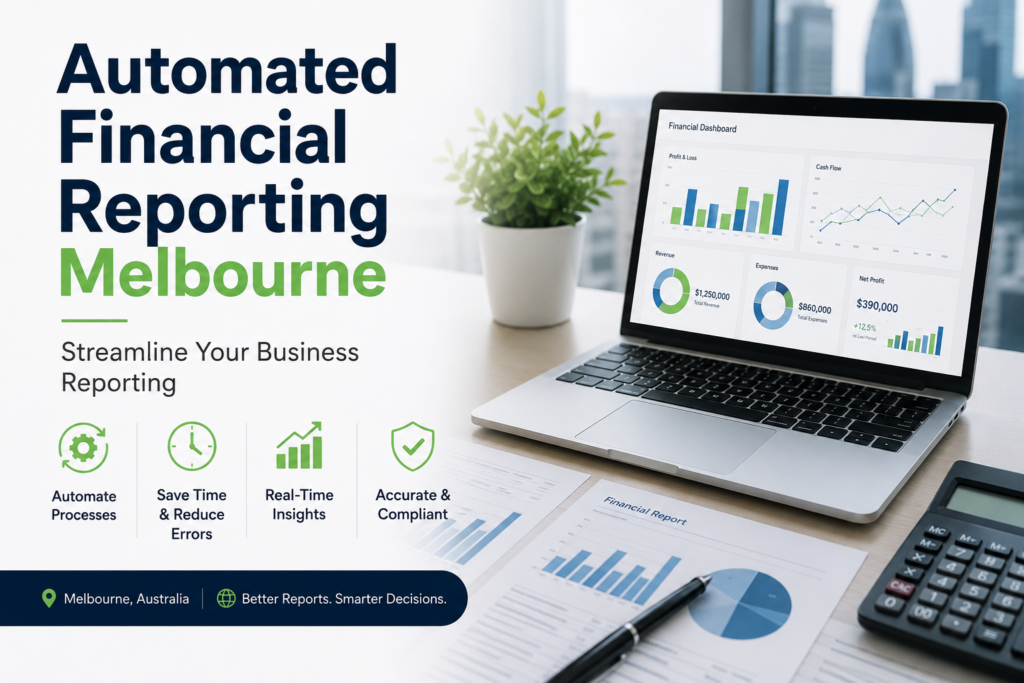
Managing financial data manually can be time-consuming, especially for growing businesses that need accurate reports to make informed decisions. Automated financial reporting in Melbourne gives businesses a more efficient way to collect, organise, analyse, and present financial information.
With automated reporting, businesses can reduce repetitive administrative work, minimise data entry errors, and gain faster access to important financial insights. Whether you operate a small business, growing company, or established organisation, automation can make financial reporting more efficient and reliable.
What Is Automated Financial Reporting?
Automated financial reporting is the process of using accounting software, financial platforms, and reporting systems to automatically collect and organise financial information and generate reports.
Instead of manually gathering data from different sources and preparing spreadsheets, an automated system can connect relevant financial data and produce reports based on predefined requirements.
Common automated financial reports include:
- Profit and loss statements
- Balance sheets
- Cash flow reports
- Accounts receivable reports
- Accounts payable reports
- Budget and variance reports
- Financial performance dashboards
- Management reports
- Tax-related financial summaries
For Melbourne businesses, automated reporting can provide a more consistent approach to financial management while allowing business owners and management teams to spend less time preparing reports.
Why Melbourne Businesses Are Using Automated Financial Reporting
Financial reporting plays an important role in understanding the financial health of a business. However, manually preparing reports can become increasingly difficult as transaction volumes and business operations grow.
Automated financial reporting can help Melbourne businesses by providing:
Faster Access to Financial Information
Traditional reporting processes may require employees to collect information from multiple systems before preparing a report. Automation can reduce this process by bringing relevant data together and generating reports more quickly.
This means business owners and managers can access financial information when they need it rather than waiting for lengthy manual reporting processes.
Improved Reporting Accuracy
Manual data entry can lead to mistakes, particularly when financial information is transferred between spreadsheets and different accounting systems.
Automated reporting reduces the amount of repetitive manual data handling, helping businesses create more consistent reports.
Reduced Administrative Work
Finance teams often spend considerable time performing repetitive reporting tasks. Automating these processes allows employees to focus on activities that require analysis, planning, and decision-making.
Better Financial Visibility
Automated dashboards and reports can make it easier to monitor important financial indicators. Businesses can track revenue, expenses, cash flow, profitability, and other key metrics without manually preparing every report.
More Consistent Reporting
When reports are prepared manually, different employees may use different processes or formats. Automated systems can standardise reporting, making financial information easier to understand and compare.
How Automated Financial Reporting Works
The exact process depends on the systems used by a business, but automated financial reporting generally follows several stages.
1. Data Collection
Financial information is collected from relevant sources such as accounting software, payroll systems, banking platforms, invoicing systems, and other business applications.
2. Data Integration
The systems are connected so that relevant financial information can be transferred or synchronised automatically.
3. Data Organisation
Financial data is categorised and organised according to the reporting requirements of the business.
4. Report Generation
The reporting system generates predefined financial reports, dashboards, or summaries based on the available information.
5. Analysis and Review
Business owners, managers, accountants, or finance teams can review the reports and use the information to support financial decisions.
Key Benefits of Automated Financial Reporting in Melbourne
Choosing automated financial reporting can offer several benefits to local businesses.
Save Time
Automation reduces the need to repeatedly collect, enter, and format financial information. This can save valuable time for business owners and finance teams.
Make Faster Decisions
Access to current financial information can help management identify changes in revenue, expenses, cash flow, and profitability more quickly.
Reduce Manual Errors
Automating repetitive processes can reduce the risk of common data entry and calculation errors.
Improve Business Planning
Accurate financial reports can support budgeting, forecasting, resource planning, and broader business strategy.
Scale With Business Growth
As a business grows, its financial data and reporting requirements usually become more complex. Automated systems can help businesses manage increasing volumes of information without relying entirely on additional manual processes.
Who Can Benefit From Automated Financial Reporting?
Automated financial reporting can be useful for businesses across many industries.
It may be particularly valuable for:
- Small and medium-sized businesses
- Professional service firms
- Retail businesses
- Construction companies
- Property businesses
- Hospitality businesses
- Technology companies
- E-commerce businesses
- Multi-location businesses
- Businesses with growing finance teams
The right reporting solution depends on the company’s size, accounting systems, reporting requirements, and financial processes.
Automated Financial Reporting vs Manual Reporting
Manual reporting typically involves collecting information, updating spreadsheets, checking figures, creating charts, and distributing reports.
Automated reporting can perform many of these repetitive tasks through connected systems and predefined workflows.
| Manual Financial Reporting | Automated Financial Reporting |
|---|---|
| Requires significant manual data entry | Reduces repetitive data entry |
| Reports may take longer to prepare | Reports can be generated faster |
| Higher risk of spreadsheet errors | Can reduce manual errors |
| Data may be spread across multiple files | Data can be integrated across systems |
| Time-consuming updates | Automated updates can improve efficiency |
| Often dependent on individuals | Standardised reporting processes |
Automation does not remove the need for financial expertise. Instead, it gives finance professionals better tools to work with financial information and interpret the results.
Choosing an Automated Financial Reporting Solution in Melbourne
Businesses should consider several factors before implementing an automated reporting system.
Compatibility With Existing Software
The reporting solution should work effectively with the accounting and business systems already being used.
Reporting Requirements
Consider which reports the business needs regularly and whether the system can produce them in the required format.
Data Security
Financial information is sensitive, so businesses should assess security controls, user access, data protection, and backup procedures.
Scalability
The system should be capable of supporting the business as transaction volumes, employees, locations, and reporting requirements increase.
Ease of Use
A reporting system should be accessible to the people who need to use it. Complicated systems can reduce adoption and make reporting unnecessarily difficult.
Support and Implementation
Businesses should also consider the level of technical support, system implementation assistance, training, and ongoing maintenance available.
The Role of Automated Reporting in Better Financial Management
Financial reporting is not simply about producing numbers. The real value comes from understanding what those numbers mean.
Automated financial reporting can give business owners and management teams quicker access to financial information, allowing them to identify trends and potential issues earlier.
For example, management may use automated reports to monitor:
- Monthly revenue
- Operating expenses
- Profit margins
- Cash flow
- Outstanding invoices
- Budget performance
- Departmental expenses
- Financial trends
Having this information readily available can support more informed and timely business decisions.
Why Invest in Automated Financial Reporting?
For many Melbourne businesses, financial reporting becomes increasingly demanding as the organisation grows. Relying entirely on manual spreadsheets and repetitive processes can make it harder to maintain efficient reporting.
Automated financial reporting provides a structured way to streamline these processes while improving access to financial information.
The goal is not simply to automate reports. It is to create a more efficient financial reporting process that supports better visibility, planning, and decision-making.
If your business is spending too much time preparing financial reports, it may be worth reviewing your existing reporting processes and identifying which tasks can be automated.
Frequently Asked Questions About Automated Financial Reporting Melbourne
1. What is automated financial reporting in Melbourne?
Automated financial reporting in Melbourne refers to using software and connected financial systems to automatically collect, process, organise, and present financial information. It can help businesses reduce manual reporting tasks and access financial information more efficiently.
2. What types of financial reports can be automated?
Businesses can automate various reports, including profit and loss statements, balance sheets, cash flow reports, accounts receivable reports, accounts payable reports, budget reports, variance reports, and financial dashboards.
3. Is automated financial reporting suitable for small businesses?
Yes. Small businesses can benefit from automation by reducing repetitive administrative work and gaining easier access to financial information. The appropriate solution will depend on the business’s size, budget, accounting system, and reporting requirements.
4. Can automated financial reporting integrate with accounting software?
Many automated reporting solutions can integrate with accounting platforms and other business systems. The available integrations depend on the specific software being used and the reporting solution selected.
5. How can automated financial reporting improve accuracy?
Automation can reduce repetitive manual data entry and calculations. By pulling information directly from connected systems and applying predefined reporting rules, businesses can reduce some common manual errors.
6. Does automated financial reporting replace accountants?
No. Automation is designed to streamline repetitive reporting tasks, not replace professional financial expertise. Accountants and finance professionals can use automated reports to spend more time analysing financial information, advising businesses, and supporting strategic decisions.
7. How much does automated financial reporting cost in Melbourne?
The cost varies depending on the software, number of users, reporting requirements, integrations, implementation needs, and level of customisation. Businesses should assess their requirements before comparing pricing options.
8. Is automated financial reporting secure?
Financial reporting systems should include appropriate security measures such as access controls, authentication, data protection, and secure data storage. Businesses should review the security features of any reporting solution before implementation.
9. How long does it take to implement automated financial reporting?
Implementation time depends on the complexity of the business, number of systems being connected, volume of financial data, and level of customisation required. A straightforward setup may be completed relatively quickly, while complex environments can require more planning and testing.
10. Can automated financial reporting help with cash flow management?
Yes. Automated cash flow reports can provide businesses with clearer visibility into incoming and outgoing funds. This information can help management monitor cash positions, outstanding invoices, expenses, and financial trends.
11. What should I look for in an automated financial reporting system?
Businesses should consider software compatibility, reporting capabilities, data security, scalability, ease of use, integrations, customisation options, support, and overall cost. The best solution should align with the company’s existing financial processes and future requirements.
12. Why should Melbourne businesses consider automated financial reporting?
Melbourne businesses can use automated financial reporting to reduce repetitive administrative work, improve reporting consistency, access financial information faster, and support better financial decision-making. It can be particularly useful for businesses experiencing growth or dealing with increasingly complex financial data.
Conclusion
Automated financial reporting in Melbourne can help businesses modernise their financial processes and reduce the time spent on repetitive reporting tasks. By connecting financial systems and automating routine reporting processes, businesses can improve efficiency, gain greater visibility into their financial performance, and make decisions based on more accessible financial information.
Before choosing a solution, businesses should assess their current reporting processes, software integrations, security requirements, and future growth plans. A well-designed automated reporting system can become an important part of an efficient and scalable financial management process.

James Scott was born in Missouri and studied at the University of Central Missouri. Currently working as Manager at ActoutLoud, James Scott helps readers learn the fields of Law, Marketing, Construction, Education, Health, etc hone their skills, and find their unique voice so they can stand out from the crowd.
Frequently Asked Questions
What is automated financial reporting and how does it work?
Why should Melbourne businesses adopt automated financial reporting?
How does automated financial reporting improve decision-making for businesses?
Who can benefit from automated financial reporting in Melbourne?
What factors should Melbourne businesses consider when choosing an automated financial reporting system?
How to Cite This Article
James Scott. "Automated Financial Reporting Melbourne: Streamline Your Business Reporting." Act Out Loud, August 8, 2026. https://actoutloud.org/automated-financial-reporting-melbourne-streamline-your-business-reporting/